
Could artificial intelligence (AI) be impacting your relationship?
You might be worried about how AI is changing society and romantic relationships, and rightly so. Although divorce rates have remained steady, the current divorce rate is still 8.6 per 1,000 for men and 8.5 per 1,000 for women, which is a return to pre-pandemic levels.
If you’re concerned about AI, we’ve investigated whether AI is having a real effect on relationships and whether it’s resulting in changes to the UK’s divorce rates.
How is AI impacting relationships?

AI is already having a profound impact on relationships, with a huge proportion of the population now using AI chatbots to form intense social and emotional connections.
According to one study, nearly 79% of young people aged 18-24 had used an AI companion. About half of this group were also using them regularly. Furthermore, one-third of all UK adults admitted to using AI for emotional support.
It’s also estimated that around 16 million users worldwide use AI companion apps, with a large proportion of them from the UK. Experts are already concerned about the impact on human relationships, flagging issues like:
· Treating AI chatbots in the same way as human relationships.
· Disrupting relationships. According to a U.S. study of AI apps, apps like Replika and Anima are frequently mentioned in divorce applications. Note that this information isn’t recorded in UK divorce applications.
· Changing social dynamics.
· Altering attachment patterns.
· Replacing human relationships entirely.
In short, we’re starting to see how AI is eroding social skills and leading to a heightened dependence on machines to handle complex emotional issues.
Is the rise of AI affecting the divorce rate?
There’s no evidence to show that rising AI use is affecting divorce rates anywhere in England and Wales. In fact, a study of divorce rates in England and Wales shows that 41% of marriages end in divorce, the UK has actually seen the rates of divorce decline over the past two decades.
Since the introduction of no-fault divorce laws in 2022, the Office for National Statistics no longer collects the reasons for divorce any more. That means it’s impossible to tell whether issues like ‘AI infidelity’ are causing more divorces given that the divorce application will simply state the marriage has irretrievably broken down but not provide the reasons for this.
What we can tell, though, is that we’re seeing the effect of AI over in the U.S., with the Institute for Family Studies reporting a growing number of divorce applications citing AI. So, it’s not inconceivable that the same trend may also be happening in England and Wales.
How AI may be causing more divorces
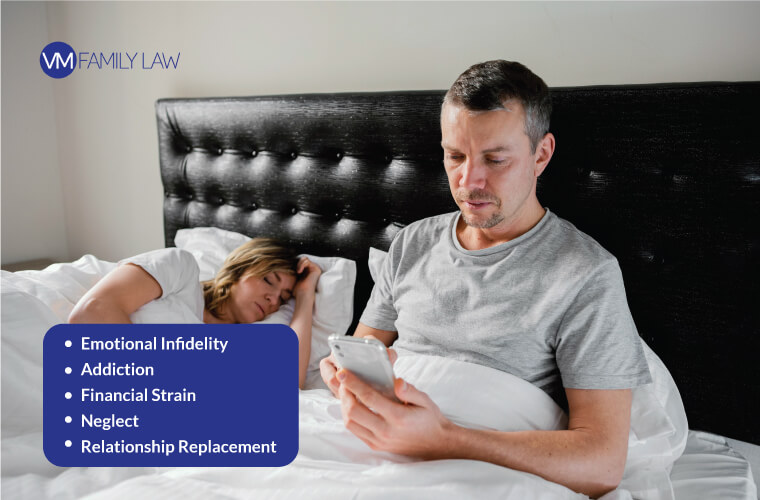
Assuming that AI is increasing divorce rates, there’s no single answer as to why. Part of the reason could be emotional infidelity, addiction, financial strain and general neglect. There’s also the risk that some are using AI chatbots as a replacement for real relationships.
Let’s explore these reasons to help you understand what could be going on if you’re worried about the potential for AI interfering in your home life:
· Emotional Infidelity – The biggest worry is that some users are developing romantic bonds with their chatbots. And it’s not uncommon, with a third of UK citizens having used these apps for emotional support and companionship.
· Addiction – It’s hard to pay attention to relationships when you’re glued to a screen. AI addiction is a real thing, with an estimated 1.8 million users relying on generative AI daily.
· Financial Strain – Finances are among the most common sources of conflict in relationships. Constantly paying for AI subscriptions can strain ties when budgets are tight. Today, the UK public spends £265 million annually on personal AI subscriptions.
· Neglect – If your partner is constantly using AI, the always-on nature of these tools often acts as an alternative to confronting real-life problems. And it’s a massive problem, with one in five people feeling their partner doesn’t pay them enough attention.
· Relationship Replacement – Some people can become so involved in AI platforms that they essentially build a relationship simulator, which causes them to disengage from their partners. A recent report found that one in five Britons had already turned to AI for help with personal issues.
Of course, we understand that divorces rarely boil down to a single reason.

How divorce solicitors are adapting to the rise of AI and its impact on couples
AI is a reality in every sector, and the legal industry is no exception. More and more solicitors are integrating AI tools into their work processes, including document management. However, despite the potential benefits of AI, divorce solicitors must also consider the role AI has played in their clients’ relationships.
For example, solicitors are increasingly having to address the emotional connections people have formed with AI chatbots. Thankfully, the end of fault-based divorces means fault no longer has to be proved, reducing conflict. Nevertheless, AI use reverberates throughout the process, including how clients may approach the legal process.
Navigating the world of AI in relationships and the legal process can be tough. That’s why working with experienced divorce solicitors at VM Family Law can deliver clarity. To learn more about supporting your divorce proceedings, contact us now.