
Anyone who’s gone through a divorce will tell you about the stress and disruption the whole process causes. Beyond the emotional turmoil, there’s also the issue of what it means for your assets.
With5.7 million private sector businesses in the UK, you may be worried about what happens to the company you’ve built should you initiate divorce proceedings. In this guide, we discuss how business assets factor into the divorce process and how you can protect your business.
Will your business be taken into account in a divorce?
Business assets are classified as a financial resource. In other words, your business will be considered matrimonial property, and, therefore, must be included in defining a fair financial settlement.
The Family Court will assess the company’s value and consider any contributions, including financial and non-financial, from both spouses. Does that mean you’re going to be forced to sell your business? Not usually, but there may be a need to offset its value through other assets or by providing a lump sum payment.
In truth, forced sales are rare. According to the Courts and Tribunals Judiciary, courts are unlikely to order a sale because they tend to disrupt businesses and provide little actual financial benefit to either side.
How are business assets divided in a divorce?

The first step is to value the business and incorporate it into the total value of the matrimonial estate before deciding what a fair financial split would be. The type of business plays a huge part in these valuations. Here’s what that might look like:
· Sole Trader – The simplest to value because there’s only a single owner with direct control of assets and debts (check out how debt is divided during a divorce).
· Partnership/LLP – Essentially, the same process as a sole trader, minus the holdings of the other owners. In partnerships involving both spouses, each party’s contributions will be accounted for.
· Limited Company – Limited companies are separate legal entities, and so a court can’t demand the same of one of these outright. Instead, the focus will be on your holding and any active shareholder agreements, such as those that restrict share transfers.
The complexities of dealing with multiple shareholders and owners are one of the reasons the Family Court prefers to keep active businesses running. Instead, they look for other ways to reach a fair financial settlement, such as finding value in non-business-related assets.
Factors that influence how business assets are divided in a divorce
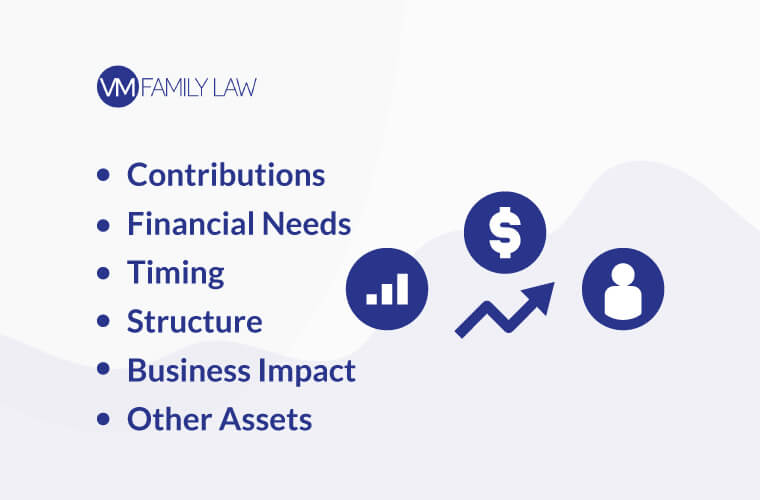
Not every scenario is the same. There are no hard-and-fast rules that the court will apply to decide how to deal with business assets. Instead, they’ll run through a range of factors to decide what the best way is to manage these assets.
So, which factors will the courts consider?
· Contributions – The Family Court will look into financial and non-financial contributions from both spouses, especially if the business grew significantly during the marriage. Note that the latter might also include emotional support, childcare, and unpaid work.
· Financial Needs – What does each party need going forward? What will each party’s future income look like? What are the needs of your children?
· Timing – When was the business formed? A business that has been running for 20 years before you got married is unlikely to be treated in the same way as a business started during your marriage.
· Structure – What type of business are you running? Unpicking complex shareholder agreements within a limited company will receive a different treatment from a small business operated under a sole trader structure.
· Business Impact – The Family Court can use various methods to divide business assets, including sales, buyouts, and share transfers. In all cases, the court will prioritise minimising the disruption to the business.
· Other Assets – Since the court prefers to keep businesses together, they may also look at other financial assets to balance out the value of the business. For example, if you’re running a profitable business, you might choose to give up a larger share of the sale of the family home or provide a lump sum payment to protect your business assets.
It’s also worth mentioning that a study from the University of Bristol found that longer marriages tend to result in more even splits of assets. Whilst not a defining factor, the court will also look at how long you’ve been married.
How to protect your business assets in a divorce

The number one principle to bear in mind is that your business can be split into pre-marriage and during-marriage phases. In other words, the value of your company before you got married is considered non-matrimonial property, whereas any growth during your marriage is considered matrimonial.
The challenge is separating the two, which is why keeping accurate paperwork is crucial. It’s also worth bringing in valuation experts to distinguish between the two periods.
Generally, the best way to protect your business assets is to take action before divorce, and preferably, before you get married in the first place. However, there are still actions you can take during divorce proceedings.
Pre-emptive business asset protection
The number one course of action is to sign a prenuptial or postnuptial agreement outlining how business assets are divided. The Court tends to respect these documents as long as they’ve been properly drafted, are able to meet needs and are deemed to be fair.
Beyond that, you can also incorporate the potential for divorce into your shareholder agreements. These may include divorce clauses like buy-back or pre-emption rights for other shareholders.
Working with corporate solicitors to structure your business appropriately, utilising family trusts, and keeping separate finances between your personal and business affairs from day one can also help defend your business assets.
Protecting your assets during divorce
Your options are limited if you’re only thinking about asset protection after you’ve already filed for divorce. So, what should you do in this scenario? Follow these steps:
· Get a valuation from an agreed independent expert early in the process.
· Organise your documents to demonstrate business value at key stages, like before cohabitation/marriage and after separation.
· Offset value by offering your ex-spouse a larger share in other assets, and keep your business intact.
If you’re still on relatively good terms with your spouse, it’s strongly recommended that you turn to divorce mediation to reach a fair settlement. It usually results in a more cost effective, amicable division of assets than letting a judge do it for you.
The VM Family Law team knows how stressful it can be to deal with asset division during an emotional time. Work with our expert divorce solicitors and let’s help you keep more of what you’ve built. To learn more about dealing with the financial aspects of dividing your assets, contact us now.