
Dividing your assets after a divorce often feels like another layer of pressure heaped upon an emotional powder keg. Believe it or not, division disputes usually don’t involve enormous sums of money. According to the latest stats, the median total assets of divorcing couples is just £135,000, with nearly a fifth having no assets at all.
Even so, you want to keep more of what you own whilst avoiding a protracted courtroom battle. That’s why this guide provides you with the expert advice you need to resolve asset division disputes with as little friction as soon as possible to enable you to move on with your life.
Common asset division disputes in divorces
Contested financial remedy orders are on the rise, with a 66% increase in disputes in 2024. This represents 10,300 cases, the highest in 16 years. But what are the leading causes of these disputes?
The family home is the main area of dispute, as couples argue over whether to sell it, buy out the other spouse’s share, or offset the value against other assets.
Pensions are also increasingly becoming a source of tension, as they’re often the largest asset and valuing them and calculating the appropriate division can be complex.
Other sources of conflict include pets, business interests, assets that might have been inherited, gifts, and even non-financial contributions, such as arrangements for children – childcare.
Options for resolving disputes over asset division during a divorce
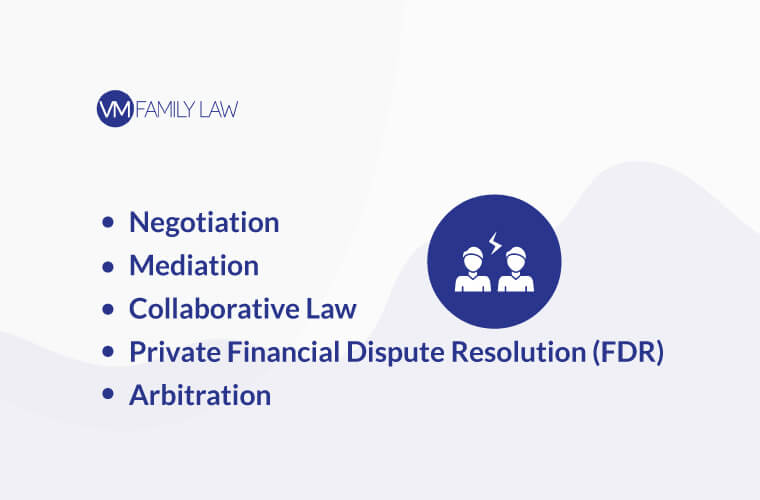
Dispute resolution doesn’t have to mean going to court. In fact, just one in ten cases ever reach court as contested proceedings. Most disputes are resolved through other means, and the Family Court encourages exploring all possible alternatives, with standing in front of a judge being the last resort.
So, what options are available to you?
· Negotiation – Either negotiating directly with your ex-spouse or through solicitors. If you can reach an agreement this way, it will serve as the foundation for a Consent Order. An order is necessary to ensure the agreement reached is legally binding.
· Mediation – Where negotiation fails, the next step is mediation. A neutral mediator will moderate discussions between you and your ex-partner to assist you both in reaching a settlement.
· Collaborative Law – Collaborative law is a process in which you and your ex together with your solicitors will meet to resolve issues as part of a structured process.
· Private Financial Dispute Resolution (FDR) – The FDR process takes the form of a private court-style hearing. The point is to work with a judge or barrister to get an idea of what a court might order. This can form a baseline for what’s fair, and often puts people off going straight to court.
· Arbitration – Arbitration is similar to court because an independent arbitrator will make a final decision on asset division. It’s legally binding, but, unlike a court, the process is more private and much faster.
If none of these routes work for you and your ex, or they don’t serve your specific situation, only then should you be looking at court. On a side note, it’s usually better to avoid court because it saves time and money, and avoids the risk of an outcome being forced upon you which neither of you may be happy with.
How will the Family Court resolve asset disputes in a divorce?

Judges ultimately examine asset division through what’s known as Section 25 Factors, or the concept of fairness. They’ll look at the:
- Needs of both parties and any dependent children;
- Ages of the parties;
- Resources which each party has or is likely to have;
- Standard of living;
- and the financial/non-financial contributions of each party.
Additionally, they’ll examine the duration of the marriage and the value of any benefits lost upon divorce such as pensions.
Understand that the 50/50 split is a myth. Instead, it’s a starting point for the division of the matrimonial assets. Ultimately, unequal splits are common, especially when children are involved. If you have kids, the court will look at providing for their welfare first, which is one of the main causes of unequal splits.
Since divorce settlements are approved by the Family Court, even if you resolve a dispute amicably, the court still has the power to step in if the proposed settlement is grossly unfair by raising questions and can ultimately refuse to approve any agreement which it deems to be unreasonable.
Working on asset disputes in a divorce with and without a solicitor

Do you need a solicitor to resolve asset disputes? From a legal perspective, no, you don’t. However, we recommend taking legal advice at the very least, so that you know your rights and what you might be entitled to.
If you’re taking the DIY approach, it’s crucial to list all assets and debts, including individual and joint accounts and pensions. Valuing and agreeing on a fair valuation for these assets will then form an estimate for what you’re dividing.
Opting for DIY asset division is possible for relatively simple asset divisions and when you’re still on cordial terms with your ex.
- Note that a court can still reject your final division if it’s believed that an agreement was obtained through coercion, misinformation, intimidation, or in cases where the agreement is clearly unfair.
Even in these cases, it’s still better to at least take some legal advice, even if you don’t want a solicitor to drive the process. You should also be aware that if the agreement is not embodied in a court order then it is not likely to be legally binding.
So, when should you work on asset disputes with a solicitor?
- When finances are complex, such as when you’re dealing with pensions, businesses, spousal maintenance, offshore assets, potentially hidden assets, or substantial wealth.
- When you’re unable to communicate with your ex-spouse cordially.
- When multiple attempts at resolving the dispute have failed.
- When you believe you’re going to have to take the dispute to court.
- When you think that you’re the victim of intimidation or coercion.
- To obtain a court order
In an ideal world, you would be able to handle asset division with your ex amicably, but seeing a marriage come to an end means you’re probably stressed and emotional. Being able to look at asset division strategically and rationally is easier said than done.
That’s why turning to expert divorce solicitors from VM Family Law is such a powerful tool. Our legal experts can explain your rights and offer objective guidance on what a fair financial settlement looks like. If you’re looking for support in dealing with asset splits, contact us now.