
Going through a divorce means disentangling your financial affairs from your ex-partner. Set against a challenging emotional backdrop, the last thing you’re likely thinking about is the tax implications of breaking up.
Nevertheless, we know that the consequences of one of the most emotionally taxing parts of your life can easily extend into the financial side. Dealing with HMRC simultaneously is something you just don’t need or want during this difficult time.
In this guide, we discuss the tax implications of divorce, and which taxes you have to watch out for.
What types of tax you need to consider in a divorce
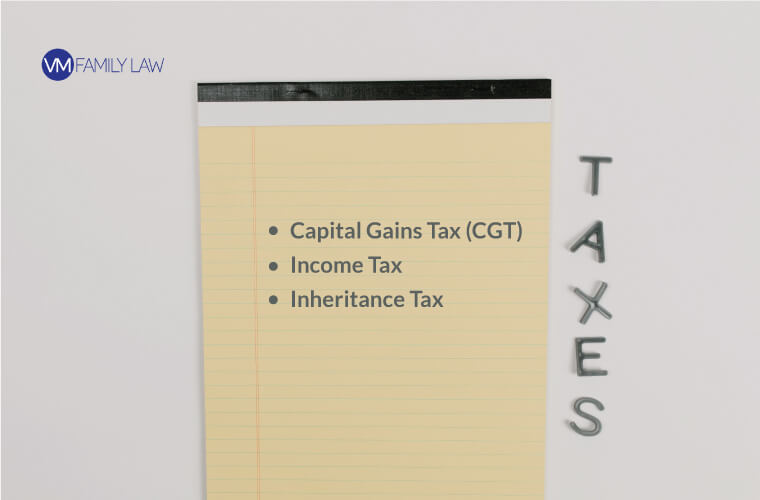
Going through a divorce and dividing assets is often when negotiations become contentious. In longer marriages, this tends to be more difficult, as discussions about matrimonial and non-matrimonial property aren’t as straightforward. And with the median duration of marriages ending in divorce being 12.7 years, the tax implications can be massively confusing.
In terms of the taxes you’ll usually deal with, these are:
· Capital Gains Tax (CGT) – CGT is the main tax you’ll have to deal with when dividing things like shares and properties. It’s charged on all profits for an array of assets.
· Income Tax – Any income will be taxed across that tax year. But divorce can change how you’re taxed individually. Additionally, it can alter other aspects, including how much you receive in certain benefits, including Universal Credit.
· Inheritance Tax – Although divorce-based transfers usually exempt you from inheritance tax, this protection only extends until your final divorce order. That’s why, moving forward, you must factor your divorce into your future inheritance tax planning.
Finally, you may be wondering what the impact on your pension could be. Luckily, if a pension sharing order is imposed, you won’t have to worry about any immediate tax implications. On the other hand, how you access these funds years down the line could trigger tax events.
The tax implications of divorce
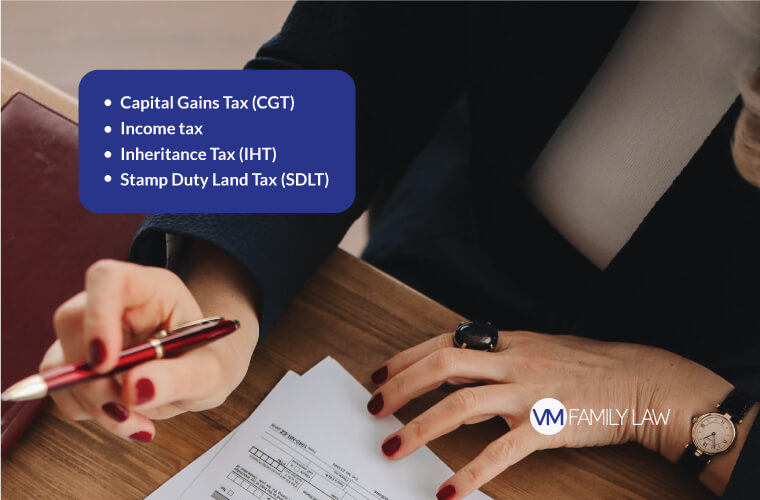
In England and Wales, the law is designed to largely protect divorcing couples from huge tax bills simply because their relationships reach a natural end. Divorce settlements are almost entirely tax-free for capital lump-sum transfers and maintenance payments.
Asset transfers, though, must be handled with more care. It’s not just about avoiding any initial tax bills but potentially opening yourself up to unintended tax consequences in the years ahead. Let’s take each of the main taxes in turn to show you how divorce could affect them.
Capital Gains Tax (CGT)
CGT is the tax most couples worry about, especially if they’re selling the family home. Under current CGT rules, you’re usually exempt from CGT if you transfer, gift or dispose of the family home before finalising a divorce but this is not the case when dealing with other assets. This is why it is important to always seek expert tax advice from an accountant.
Income tax
Any payments made to cover child support or spousal maintenance are entirely tax-free for the person receiving them. Likewise, since these payments are considered to be a non-taxable event, the person paying them can’t claim them as a deduction from their own income tax bill.
If your divorce involves income-producing assets, though, you should be aware that the tax relief only applies to lump-sum settlements. Income-producing assets, such as shares that pay dividends or buy-to-let homes, will still result in an income tax bill on any revenue earned.
Inheritance Tax (IHT)
IHT doesn’t apply to transfers between former spouses who have divorced. You’ll benefit from this protection until your final divorce order goes through. Do be aware that, however assets are divided, this could still result in IHT liabilities in the future.
Stamp Duty Land Tax (SDLT)
SDLT normally applies to the transfer of property or land. However, it’s usually exempt if transferred through a court order or divorce settlement but if a property is being purchased then stamp duty will need to be paid.
What about the Marriage Allowance?
Claiming the Marriage Allowance to decrease how much tax you pay during the marriage is a perfectly viable way of keeping more of your money. Currently, the Marriage Allowance rules let you transfer £1,260 of your personal allowance to your partner, resulting in a potential saving of £250 a year for a high earner.
Naturally, if you get divorced, it’s your responsibility to notify HMRC that your circumstances have changed, and you’ll no longer be able to claim this tax relief.
How working with a solicitor can help you with tax and divorce
Straightforward divorce scenarios are often surprisingly simple when it comes to the tax implications. If your main assets are the family home and pensions, then usually there are no worries over CGT, SDLT or surprise income tax. However if in doubt then expert tax advice should always been sought from an accountant. If you do not have your own accountant then VM Family Law can arrange to obtain an expert tax report on your behalf from an experienced accountant.
The challenges begin when other assets are factored into the divorce mix, especially if you have income-producing assets, shares, investments, businesses, multiple properties. How you split these assets could have huge tax implications that reverberate for years to come if handled incorrectly.
Solicitors protect you in several ways, including:
Timing asset transfers.
Structural Financial Consent Orders to avoid unnecessary tax liabilities.
Drafting pension-sharing orders correctly to limit any tax consequences.
Stopping undisclosed assets to hide wealth.
Simple errors can result in tens of thousands of pounds in tax liabilities, which is why attempting to manage your divorce alone is never a good idea. Like all forms of financial planning, working with an expert is worth its weight in gold.
At VM Family Law, our expert divorce solicitors work with you during this difficult time to protect your wealth not only from your ex but from HMRC with input from your accountant or an accountant appointed by VM Family Law to work with you on your divorce as VM Family Law cannot provide tax advice. To learn more about keeping more of what you own as you navigate divorce proceedings, get in touch with us now.