
Divorce is a challenging time for everyone emotionally, but there’s also the glaring elephant in the room of what happens to your assets. Property, pensions and businesses all form part of any financial order, but what about emerging assets?
The UK cryptocurrency market is expected to be worth USD 913.8 million by 2033, showing just how Britons are increasingly diversifying their portfolios. The question is how these types of assets are treated when you separate from your partner.
With such limited information on the issue online, this guide covers cryptocurrency and how it fits within today’s divorce laws.
Is cryptocurrency a matrimonial asset?
Cryptocurrency can be classified as a matrimonial asset, depending on the situation. Under the Matrimonial Causes Act 1973, crypto counts as property and isn’t invisible to the court.
Under English and Welsh law, it’s treated just like any other asset and is subject to full disclosure and division. Typically, if it was acquired during the marriage or was mixed in with the family finances, it’s considered matrimonial property.
Do crypto assets have to be disclosed in a divorce?

All cryptocurrencies held must be disclosed as part of the divorce process. You’ll have to disclose it on your Form E and provide documentation to prove it’s value. Typically, this will include screenshots, account statements and your recent transaction history.
Courts are well-versed in crypto assets, with 4.5 million Britons holding some form of crypto, whether that’s Bitcoin, Ethereum or stablecoin. Although you might think it’s tough to trace, not declaring crypto is fraud and divorce settlements can be reopened if it’s discovered later.
These days, courts and solicitors alike can uncover hidden crypto through a range of means, including forensic tracing of blockchain transactions and transfers to known exchanges. Plus, the legal system can order the disclosure of exchange accounts in the same way it orders the disclosure of bank accounts.
How cryptocurrency assets will be assessed in divorce settlements
Your cryptocurrency will be treated like any other asset if you file for divorce. It doesn’t matter who purchased it originally or whose name it was in. You still have to disclose it via Form E, and only then will legal experts decide whether it counts as matrimonial property.
The most important thing to remember is that digital assets aren’t treated differently from more traditional assets. If it’s matrimonial property, it will be counted as part of the overall financial pot to be divided.
Identifying and finding cryptocurrency in a divorce
Cryptocurrency and the blockchain, by their nature, are designed to provide a degree of anonymity. It’s part of what attracts so many people to holding this asset in the first place. If you’re going through a divorce and you’re concerned your ex-partner might be hiding part of their assets through cryptocurrency, it’s natural to worry that this will be hidden from you.
Contrary to popular belief, there are ways to identify and locate hidden crypto. Examples include:
Bank Statements – Cryptocurrency is often bought in the beginning using conventional currency. Going through someone’s bank statement and identifying transactions leading to popular exchanges, like Coinbase, can be a sign that someone is holding crypto.
Device Search – Inspecting devices and email accounts for password managers, seed phrases and 2FA messages can also reveal hidden crypto.
HMRC Disclosures – Crypto gains receive the same tax treatment as the sale of any investment. Going back through someone’s self-assessment records can uncover those hidden assets.
Blockchain Tracing – Even if wallets are held in offshore exchanges or private wallets, it’s still possible to trace blockchain activity with the help of forensic accountants. This being impossible is one of the most popular myths.
Remember, not disclosing all assets on Form E at the time of divorce is classified as fraud, which can invite criminal charges. Moreover, it’s one of the few scenarios that can cause a reopening and reassessment of an existing divorce settlement.
So, even if your divorce has already been finalised, uncovering crypto later on doesn’t mean you’ve missed out on a fair and full financial settlement.
How cryptocurrency is valued in a divorce
Cryptocurrency will be treated in the same way as any stock or bond. The problem is that cryptocurrency is so volatile that an asset today could lose or gain 20% by next week. It’s an ongoing challenge in arriving at a fair divorce settlement and therefore the fairest outcome is to share the crypto currency so that both parties benefit from any gain or share any loss.
If parties would prefer not to do this then some couples might decide to assess the currency’s value at a mutually agreed-upon date or even by taking an average value over a set period. The latter is most often used when talking about a niche currency with extreme volatility.
Which option is best for you depends on the assets in question. That’s why it’s worth speaking to a legal expert who can advise you on what the best approach is.
The division of cryptocurrency and digital assets in a divorce
Your digital assets don’t exist in isolation. They exist within the framework of all matrimonial property. What happens to cryptocurrency as part of your divorce settlement really depends on how much of it there is, its value, and any other assets that might be in play.
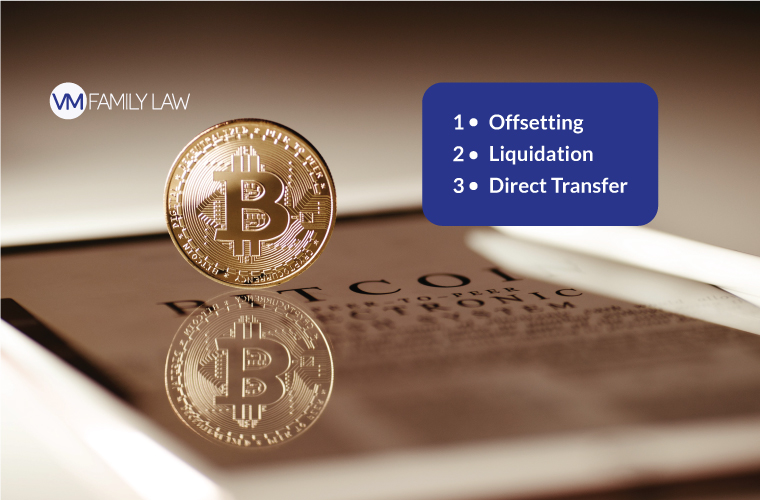
Typically, there are three methods of division:
1. Offsetting – You or your spouse wants to keep the cryptocurrency, and so the other party gets a share of another asset of equivalent value, such as cash, property or pensions.
2. Liquidation – The cryptocurrency is sold, and the cash proceeds are divided between you and your ex-partner.
3. Direct Transfer – Sometimes, a spouse may want to continue holding cryptocurrency in their portfolio. This can allow for an arrangement where a portion of the coins is directly transferred from one digital wallet to another.
Crypto isn’t the easiest asset to understand, especially if you’re not particularly tech savvy. At VM Family Law, our team is there to explain everything in clear English with practical solutions you can assess. With bespoke advice tailored to your situation, we’re proud to support you during one of the most emotionally challenging times of your life.
If you’re going through a divorce and are worried about getting the fair financial settlement you’re entitled to, schedule your consultation with us today.