
Divorce is stressful enough without having to attend court. With the introduction of no-fault divorces in 2022, the number of cases that lead to adversarial outcomes has been substantially reduced.
According to the Office of National Statistics (ONS), 74.2% of divorces were granted under no-fault legislation, up from a mere 9.2% the year before. In most cases, an amicable split is better for both parties, streamlining the process and reducing conflict.
At VM Family Law, we support families as they achieve the clean breaks and fresh starts they deserve. If you’re ready for an out-of-court divorce, speak to one of our experts for your free consultation.
What does divorcing out of court mean

An out-of-court divorce is something of a misnomer. The Family Court must process all divorces because a divorce is a legally binding dissolution of a marriage.
What an out-of-court divorce means in practice is negotiating the terms of your divorce using alternate mechanisms, such as direct discussions with your ex or via solicitors or by using collaborative law or mediation. According to the UK government website, if you can agree on issues like finances, property and child arrangements, you usually won’t have to attend court hearings.
Likewise, as long as the settlement you’ve agreed with your ex-partner is considered fair, a judge won’t impose any form of decision. Instead, your solicitor can handle the actual legal documents themselves, and you’ll never see the inside of a courtroom as a consent application can be made to the Court and approval sought from the Judge as a paper exercise.
Unsurprisingly, the out-of-court divorce is the most desirable option because it’s faster, less stressful, more straightforward and usually more cost effective.
Why you still need a solicitor to divorce without court
No part of the law in England and Wales obligates you to enlist a solicitor to conduct your divorce. Couples are free to work out their own divorce agreements and file the necessary paperwork with the court.
But just because you can doesn’t mean you should.
Solicitors continue to provide real value even in scenarios where both parties are essentially in agreement about how they want to split their assets and what their post-divorce futures look like.
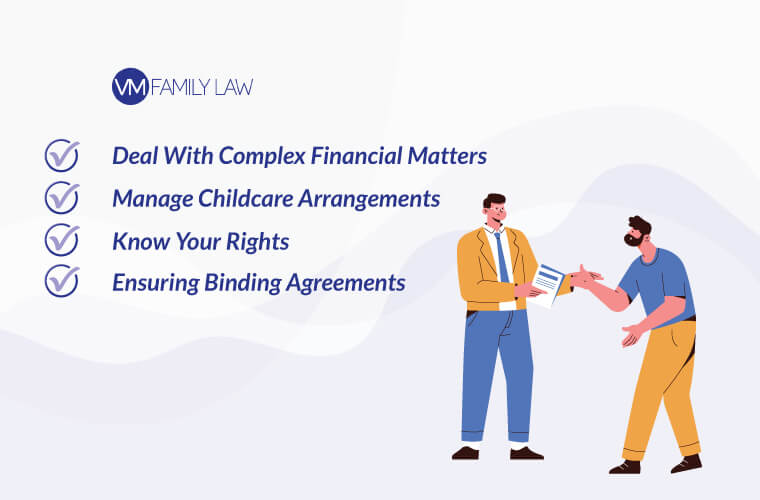
Some of the reasons you should have an experienced solicitor by your side include:
- Deal With Complex Financial Matters – Solicitors are experts in unpicking complex financial matters. They can explain what your financial entitlement looks like and how to divide assets fairly. Additionally, they can ensure that formal and legally binding financial orders are approved by the court.
- Manage Childcare Arrangements – Your family matters, and it’s vital that your children’s rights are protected. Solicitors can inform you of your rights and provide bespoke advice on childcare patterns that account for your interests and the interests of your children.
- Know Your Rights – How much do you know about your full legal and financial entitlements? The chances are you’re unaware of where you stand under the law. Solicitors provide objective advice relevant to your situation to avoid costly missteps.
- Ensuring Binding Agreements – An informal agreement, regardless of the terms you’re on with your partner, is not enforceable under the law. Binding agreements require a Consent Order to be drafted and approved by the court to guarantee that your financial agreement is backed by the full weight of the legal system. This also has the dual benefit of protecting your assets from future financial claims from your ex-spouse.
If you do not obtain a court order dismissing financial claims, then further financial claims can be made in the future, even in cases where a division of assets has been agreed and implemented.
Above all, solicitors check, recheck and check your paperwork to prevent errors that could delay your divorce or expose you to complications, including future claims.
Remember, although out-of-court divorces are more straightforward, the court is still involved in the legal process of concluding a divorce.
To learn more about what a VM Family Law solicitor can do for you as you go through your divorce, contact us for your free one-hour consultation now.
How an ‘out of court’ divorce works
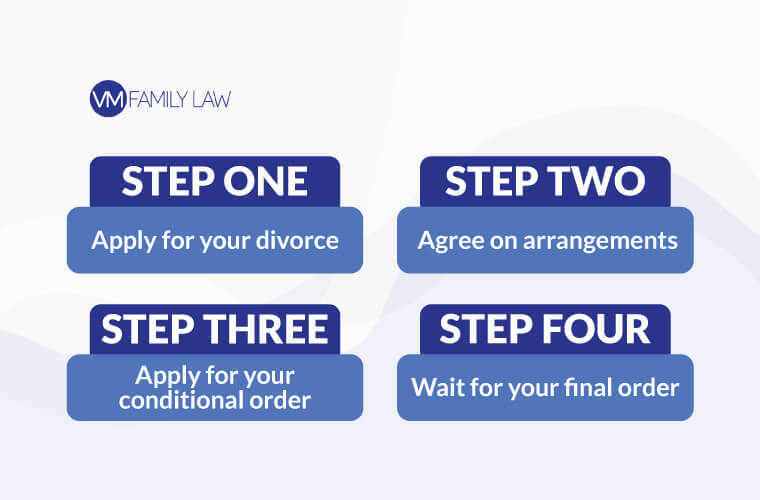
An out-of-court divorce, sometimes referred to as a DIY divorce, follows a defined procedure that covers applying for your divorce, agreeing on post-divorce arrangements, applying for your conditional order, before applying for your final order to make your divorce legally final.
Let’s split this into four steps:
Step one – Apply for your divorce
You can apply for your divorce via the government’s online portal. You can make a sole application or apply jointly with your spouse. All you need are details about you, your partner and your marriage certificate. Simply pay the fee via debit or credit card, and your divorce application is officially filed. A solicitor can do this for you if you prefer.
Step two – Agree on arrangements
If possible speak to your soon-to-be ex-spouse and try to reach an agreement on how to divide assets and agree child arrangements. Some couples can handle this amicably with few issues, but others may require more support through mediation or via solicitors.
Always seek legal advice from a family law solicitor at this point so that you know your entitlements and what constitutes a fair settlement and how to ensure any agreement is legally binding.
Step three – Apply for your conditional order
All divorcing couples must wait at least 20 weeks before they can proceed with their divorce. It’s a non-negotiable aspect of the divorce process and is designed to ensure you are sure about your decision.
After the 20-week reflection period has passed, you can apply for your conditional order. The court will review and grant it if it sees that everything is in order.
Once the Conditional Order has been pronounced, the court has the power to approve financial settlement orders.
Step four – Wait for your final order
After your conditional order has been granted, you must wait another six weeks and 1 day before applying for your final order. Again, this is a mandatory second period of reflection, and there’s no way to get around it.
Once six weeks and one day has passed, you can apply for your final order, which will finalise your divorce legally.
Divorce solicitors can help to facilitate an amicable divorce
An amicable divorce enables both parties to move on with their lives as quickly and cost effectively as possible. However, even when divorcing parties are relatively cooperative, there can still be friction that delays your divorce. Professional divorce solicitors from VM Family Law are there to address sources of conflict, advise you of your rights and provide conflict resolution that can prevent stressful court battles.
If you’d like to learn more about using divorce solicitors to streamline your divorce proceedings, contact us now.