
Getting a fair financial settlement is a hallmark of British family law. We can’t prevent the emotional stress of a divorce, but we can ensure that you get what you’re rightfully entitled to.
Under the law, both sides are entitled to a settlement that meets their needs post-separation. Despite high-profile legal cases, most divorces are surprisingly amicable, with just one in 10 couples actually going to court.
But what happens when you’re worried that your ex-partner is spitefully trying to sell, hide or burn assets? In this guide, we discuss what your options are and how freezing injunctions work.
What is a freezing order in a divorce?

Freezing orders are emergency court orders to freeze certain assets. Essentially, they stop the sale, transfer, movement and hiding of any assets listed under the injunction.
Freezing orders are implemented under Section 37 of the Matrimonial Causes Act 1973 and force third parties, including banks, to cooperate until a final divorce settlement has been reached.
These are quite draconian orders, but they’re often necessary when exes attempt to hide or dispose of assets to stop the other side from receiving what they may be entitled to.
When you might need a freezing injunction in a divorce
Freezing injunctions are designed to protect matrimonial property during a divorce. If there’s a real risk that the other party is attempting to sell, transfer or move assets to defeat a financial claim. This is where moving quickly with a freezing injunction can protect your entitlements.
Scenarios where a freezing injunction might be needed include:
Assets are being actively sold.
Assets are being transferred to third parties, including family members.
Assets are being transferred offshore.
A business is being closed or seeing its capital removed to avoid sums from being shared.
There’s a risk that assets could be removed from English and Welsh jurisdiction.
Grounds for a freezing injunction
Freezing injunctions can’t be brought in just because you’re worried that your spouse might be acting in bad faith. They’re discretionary, so you’ll have to provide a strong case with real merit which shows that their actions will result in your financial claims being severely prejudiced or defeated.
Suspicion isn’t enough. You need solid evidence that your ex-partner is actively moving, hiding or disposing of assets. This means you’ll need to identify specific assets and provide a full and frank disclosure of relevant information.
The downside is that if it’s later found that the injunction shouldn’t have been granted, your ex-partner could claim damages. This risk, along with the relatively high bar to obtaining a freezing order, is why you should speak to a family law expert, such as a VM Family Law solicitor, before deciding what your best move is.
What are the requirements for a freezing order?
Freezing orders aren’t granted freely on a “just in case” basis, which is why the basis of freezing someone’s assets must be substantial.
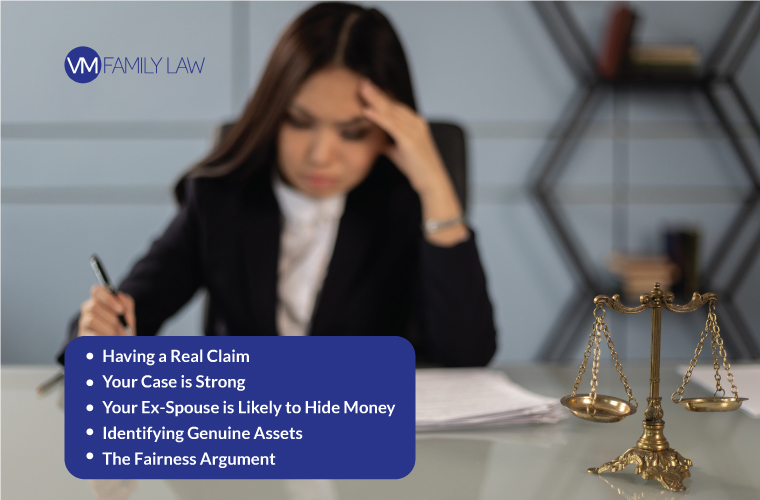
We can boil down the core requirements in plain English to:
Having a Real Claim – Worry isn’t sufficient grounds for a freezing order. You must have grounds to show that your spouse’s intentions/actions will defeat your financial claims
Your Case is Strong – Since these emergency court orders are implemented without your ex-partner being notified, any case must have a strong chance of succeeding if it’s challenged later in court.
Your Ex-Spouse is Likely to Hide Money – You must prove that if your ex-spouse’s assets aren’t frozen, they are likely to hide, move or spend their assets to prevent your financial claim. For example, if they’ve got previous history of doing this, or they have substantial overseas ties, these scenarios could support your argument.
Identifying Genuine Assets – Marking out real assets is crucial, whether that’s UK bank accounts, properties, or overseas assets as you will need to show that the disposal of such would defeat your claims.
The Fairness Argument – Any judge will look at the broader picture. Freezing orders cause real harm to a person’s life. Ultimately, the argument they’ll consider is whether the need to freeze a person’s assets is outweighed by protecting the money for a divorcing partner.
What assets can be frozen in a freezing injunction?
Practically any asset held by your former spouse can be eligible for a freezing injunction. Assets can be frozen in England and Wales, but orders can extend worldwide. However, practical enforcement can be patchy depending on the jurisdiction.
Examples of assets that you can ask a court to freeze include:
· Bank accounts
· Trusts
· Property
· Stocks
· Bonds
· Land
· Businesses
· Luxury items (cars, boats, artwork, jewellery, etc.)
Freezing orders don’t just necessarily apply to your ex, either. A third-party freezing order can be used against family members and companies to stop them from handling specific assets. These are powerful tools if you believe they’re using family and friends to help hide assets from the matrimonial pot.
If transfers have already taken place then you can apply to the Family Court to have these transactions set aside if such transactions have been carried out to defeat your financial claims.
The steps to obtain a freezing injunction
Obtaining a freezing injunction follows a defined process of establishing clear legal grounds, presenting evidence and submitting all of the necessary documentation. Here’s a summarised version of what the process looks like, so you can see how it works in practice:
1. Establish legal grounds and prepare evidence of assets that might be at risk of being dissipated.
2. Prepare the court application, a witness statement and a draft order.
3. You’ll need to provide a full and frank disclosure, even if it weakens your case, and agree to pay damages if it’s found that your ex suffers harm if the injunction is found later that it shouldn’t have been granted.
4. Attend a “Without Notice” hearing with your solicitor, where you’ll present your case to a judge. These hearings are normally done in private since the respondent won’t be notified in advance of the freezing order.
5. The freezing order may be served. You’ll also need to prepare for your ex-spouse to attend an “On Notice” hearing, where they’ll be able to argue that the freezing order should be lifted or changed.
Judges have sole discretion over whether to impose freezing orders, and there is a risk of being forced to pay damages later. That’s why working with an experienced family law solicitor is essential for ensuring your best interests are looked after.
At VM Family Law, our compassionate, straight-talking solicitors are there to give you the tailored advice you need to handle your divorce properly and obtain the fair financial settlement you deserve. If you’re worried that your spouse is disposing of or hiding assets, contact us today.