
School holidays are a chance to create memories that last a lifetime. Whilst children get excited for the school break, parents are often left struggling to manage child arrangement issues.
Today, there are 3.8 million children in separated families, meaning countless parents are facing anxiety, stress and worry as the holidays approach. Short of a Court Order, you and your ex-spouse both have equal rights and responsibilities regarding your children.
We know how complex holiday arrangements can get, so here’s some extra support for managing these difficult periods.

Managing school holidays as separated parents
Managing your child’s school holidays when separated is best done as early as possible. Even if you’re still on good terms with your ex-partner, conflicts over the holidays can quickly weigh heavily on your co-parenting arrangement.
This is especially true during the long summer holiday. Common issues include:
Holiday contact arrangements.
Disputes over travel abroad.
Equal parenting time disputes.
Communication breakdowns.
Uncertainty over your rights and responsibilities.
With divorce accounting for a third of all family breakdowns, separated parents often find themselves in limbo. In terms of the practicalities, every family differs. Some may opt to continue the same rhythm as the rest of the year or choose to alternate weeks for major holidays. Still, you might choose a straight division of three weeks with one parent and three weeks with another but this is a long time for a child to go without seeing the other parent.
The most important point is that there’s no law requiring parents to have a perfect 50/50 split for school holidays. Like all aspects of child arrangements, the court prioritises what’s in the best interests of the child. We’ve also posted a blog covering back to school after divorce.
Child arrangements and holidays: How it works
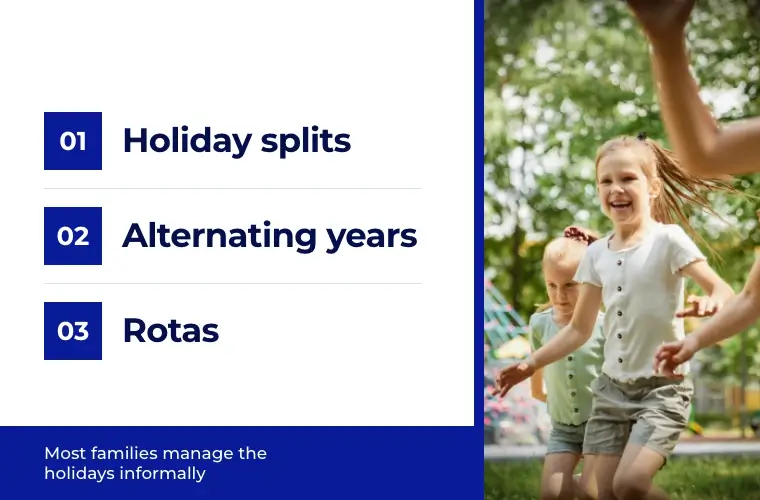
Holiday arrangements can either be managed informally or via a Child Arrangements Order (CAO). Most families manage the holidays informally, opting for:
Holiday Splits – whereby the child spends time with each parent either by dividing up each week or alternating weeks so the child has quality time with each parent which may or may not include a holiday in the UK or abroad.
Alternating Years – You’ll alternate major holiday periods, such as one parent taking the child for Easter and the other for Christmas and reversing it the following year.
Rotas – Taking the same regular-term time pattern save for if there is a holiday planned in which case the child would benefit from having a holiday.
If you can’t reach an agreement with your ex-partner, the alternative is to take out a CAO. The CAO outlines exactly what happens over the holidays. These are legally binding, meaning both parents must follow them to the letter or apply to court to have the order varied or discharged.
Domestic vs. foreign holidays
On a side note, there are slightly different rules if you want to take your child abroad for the holidays. Domestic travel within England and Wales does not require any court order, and you don’t have to ask for your ex’s permission.
In contrast, foreign travel or travel to Scotland or Ireland requires that everyone with parental responsibility provide written consent unless you have a Child Arrangements Order which states the child lives with you (in which case you can take the child abroad for up to 28 days without the consent of the other parent). This is to guard against the risk of child abduction.
Additionally, if you do not have a court order, it’s recommended to bring both the other parent’s letter of consent and the child’s birth certificate when travelling abroad. If the other parent refuses to consent then consideration should be given to applying to court for a Specific Issue Order to be able to take the child on holiday.

Why Child Arrangement Orders are useful during school holidays
School holidays are common points of conflict because both parents want to spend quality time with their children. Approximately 44% of children don’t see their non-resident parent regularly, so holidays are often a chance to create lasting memories. Establishing a CAO supports both parents in navigating holiday headaches, including:
Enforcing clear schedules that explicitly cover all major holidays.
Simplifying international travel
Providing proper regulation for shared responsibility.
It also offers clarity on travel rights and responsibility. For example, a CAO can outline who holds a child’s passport and what information should be provided and when in relation to holidays.
Steps to resolve school holiday child arrangement issues
Involving a court is usually the last resort for parents who can’t agree on how to deal with the holidays. Ideally, parents will work these issues out for themselves, and it’s what the legal system typically recommends.
Of course, we understand that some differences can’t be resolved and many former partners aren’t even on informal speaking terms. Nevertheless, if you have the opportunity to talk, follow these steps for resolving potential issues.
Step one – Start early
Don’t leave it until a week before the big summer break before you begin discussing who’s going to be caring for your child. Leaving it to the last minute creates unnecessary pressure and doesn’t allow either side to make proper plans, which can cause potential conflict to spiral out of control.
Step two – Put the child’s needs first
When talking to the other parent, make the discussion child-focused. It’s not uncommon for parents to become so focused on getting their way that it becomes all about them. With older children, ask them how they feel about the matter and what works best for them.
Step three – Outline plans formally
Mapping out different time blocks can also help avert conflict. Detailing shared weeks, holidays, and travel abroad can make it easier to reach a fair outcome for both sides.
There is also a range of parenting apps that can make it more straightforward to coordinate schedules and put communication on a neutral footing.
Step four – Opt for family mediation
If you can’t arrive at a strategy that works for everyone, consider family mediation as mediators are able to facilitate discussions to ensure these remain child focused to help parents find a way forward.
Government vouchers are available to parents to help cover the costs of mediation and the Court would generally expect parents to try mediation before making an application to court.
Step five – Apply for a Child Arrangements Order
CAOs are the last resort when you can’t come to an agreement over holiday arrangements. In this case, it’s the court that makes the decision. However, don’t assume that this will necessarily work out more in your favour as litigation is always a risk.
Courts will only make decisions regarding CAOs based on the child’s age, emotional well-being, and welfare, taking into account a child’s wishes and feelings when they are at an age where it is appropriate to do so.
Regardless of where you are in working out the holidays, we know that the legal side can be confusing and stressful. You want to do what’s best for your child, which is why our expert solicitors at VM Family Law help you understand your rights and pursue legal action where necessary.
If you’re ready to learn more about CAOs and how to manage the busy holiday period, contact us now.