
Back to school is the beginning of a new chapter for every child. In England and Wales, 9.5 million children return to the classroom every year, but amid the chaos and excitement, there are enormous strains on parents.
Uniforms, books and the school run are all issues on every parent’s mind, but those issues are compounded when you’re separated. Managing the back-to-school period after divorce comes with its own complications. So, how do you handle the new school year after divorce?
How a new school year may impact child arrangements post-divorce

Back to school brings more than anxiety for children entering a new year. Over 250,000 children in England alone experience their parents splitting up each year, which can create even more unnecessary strain on the entire family unit.
Regarding the new school year and where parents stand, all education decisions fall under the legal concept of Parental Responsibility. In other words, both parents must agree on the children's educational arrangements, unless a specific court order, such as a Specific Issue Order, says otherwise.
Ultimately, though, what worked last year won’t always work this year. Issues could include:
Changes to school pick-ups and drop-offs due to one or both parents working different shifts.
Your child may have joined an after-school club and so pick-up times have changed.
Term-time schedules have changed because the child has changed school.
Your child is older and so their school nights look different, such as more homework or different bedtimes.
These are just some examples of how life and growing up can alter childcare arrangements. Some of these are entirely unavoidable, but they can still create more points of conflict between separated family units.
In an ideal world, all of these issues would be amicably managed by the parents themselves. Of course, life isn’t always that straightforward, and so a Child Arrangements Order (CAO) may need to be put in place to manage issues relating to school.
Should you update your Child Arrangements Order (CAO)?
Child Arrangements Orders are legally binding family court orders that outline the living and contact arrangements of children.
If you can no longer comply with a CAO then you should apply to vary the order either by consent if the other parent agrees or by making your own application to court if your ex partner does not agree to your proposed amendment.
An order may need to be varied if a child moves from primary school to high school such that the existing arrangements are no longer in the child’s best interests or a shift in parental routines/jobs such that a parent can no longer comply with the existing order. However the court does not want these matters to keep coming before the court as it is not in a child’s best interests to be subject to multiple court cases.
If you are proposing to change the child’s school then you need to have the consent of everyone with parental responsibility or a court order allowing you to do this.
Updating an order, especially if there are disagreements, isn’t always straightforward. Working with a family law solicitor guides you not only through filling out all the necessary forms but also through navigating negotiations and exploring alternative options such as mediation.
Additionally, enlisting legal help protects you against costly litigation errors that can delay or derail your attempt to change your CAO. A solicitor prepares all necessary evidence, such as school reports, to support your legal arguments and ensure your child's best interests are protected.
Communicating with the school regarding child arrangements as separated parents
You and your ex-partner both have a right to be involved in your child’s education, and schools are well-versed in dealing with families involving separated parents. Approximately half of all UK children are growing up with just a single biological parent.
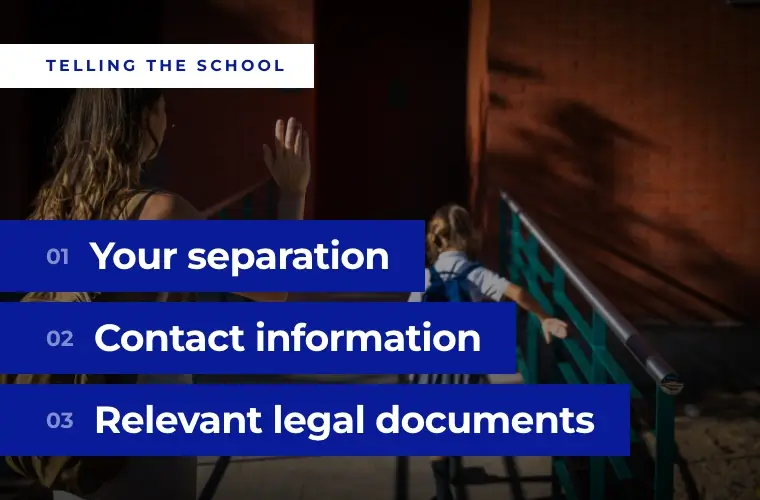
But schools need proper clarification on your arrangements, including:
Informing the school of your separation and who still has parental responsibility, whether that’s one or both.
Contact information for each parent.
Copies of any relevant legal documents, including CAOs if you have the permission of the court to disclose these.
You should also request that the school send out duplicate reports, letters and emails to both parents. These days, many schools rely on digital portals that can provide seamless access to both parents.
On a side note, although both parents have a right to participate equally in their child’s education, schools will not take sides. Like the Family Court, schools are obligated to focus exclusively on the best interests of the child.
Using mediation to manage child arrangements around schooling
When you cannot reach an agreement with your ex-partner, it may be time to consider mediation. It’s an alternative to going to court with the aim of providing a neutral mediator to help work through your issues and create a Parenting Plan that works for both sides.
Your Parenting Plan is designed to address the practicalities of your child’s education, including school holidays, drop-offs and term-time routines. For older children, you may also be able to access child-inclusive mediation, which allows your child to express their feelings and preferences with a trained mediator.
Mediation can be as minute or as expansive as you need it to be. For example, the issue could be as small as the school run or as significant as choosing a new school. It’s an ideal alternative to the stress and hassle of going to court.
However, we know that parents are stretched thin. That’s why in England and Wales, parents can access a £500 Family Mediation Voucher.

With that in mind, if you’re struggling to contend with a disagreeable parent as the new school year approaches, it’s time to act. Speak to a compassionate family law solicitor from VM Family Law who understands where you’re coming from and will offer full and frank advice. Whether you’re looking to change a CAO or just need some advice about your legal rights as a parent, contact us today.