
Family separation is tough on everyone, but even more so on your children. Today, an estimated 3.9 million children are raised in separated families. You want what’s best for your child, but hoping for the best isn’t a solid foundation to build your future co-parenting relationship on.
Many parents manage co-parenting through parenting plans, which are written agreements detailing how you’ll both care for your children. However, in England and Wales, this isn’t a legally binding document on its own, which is where family lawyers come in.
In this guide, we discuss how parenting plans work, and how a family solicitor can support your family in doing what’s best for your child.

What a ‘parenting plan’ post-divorce actually is
Parenting plans are voluntary agreements separated parents create to manage the day-to-day practicalities of raising your child. It’s a formal written document designed in a way that’s easy to reference to resolve conflicts before they start spiralling.
Here’s what a standard parenting plan usually covers:
- Living arrangements, including overnight arrangements.
- Holiday arrangements.
- How big decisions are handled, such as choice of school, the child’s GP, and taking your child abroad.
- Contact arrangements that outline how a child can stay in touch with both parents.
- Handling new partners.
- How the parenting plan might change as your child gets older.
No two parenting plans are the same because no two families are the same. As you’d imagine, the success of these plans depends on the willingness of both parents to cooperate, regardless of how they personally feel about each other.
Are parenting plans legally binding?
Creating a parenting plan is a major step forward after a divorce, but these aren’t legally binding just because you wrote them down. The crux of a parenting plan is that it’s an informal written agreement.
Since they aren’t formalised by any court, there’s no way to enforce them. They can be used in family court as evidence if you end up in a dispute later, though. Despite this, the Children Act 1989 actively encourages parents to reach informal agreements without going to court.
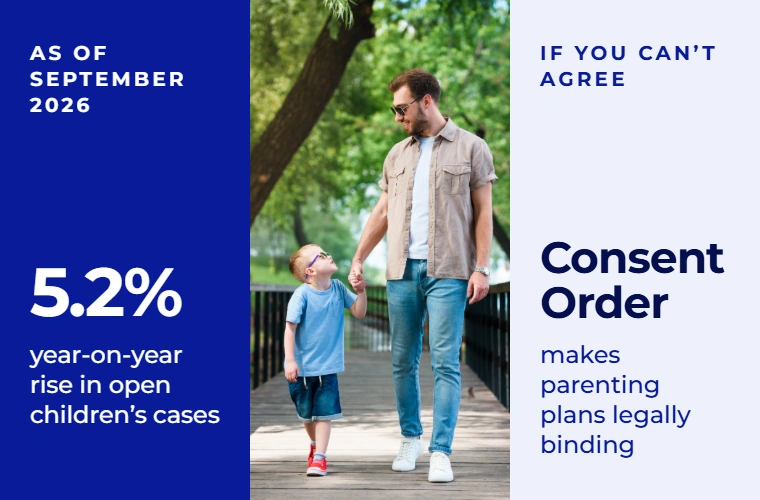
However, if you can't agree with your ex, or you’re worried they won’t stick to what was agreed, you can make parenting plans legally binding through what’s known as a Consent Order. A judge will review it and, if approved, you’ll have a legally binding Child Arrangements Order in place.
It’s an increasingly popular option, too, with a 5.2% year-on-year rise in open children’s cases, as of September 2026.
How is a parenting plan different from a court order?
Parenting plans don’t differ much from court orders in terms of the issues they address. The difference is that a court order is legally binding, meaning if a parent breaks it, they can be taken to court.
One potential downside of a formal Child Arrangements Order is its lack of flexibility. Since parenting plans are informal, parents can change them at will as and when needed. Altering a Child Arrangements Order means going back to court to have it modified. Essentially, a Child Arrangements Order means following it to the letter.
On a side note, judges are the ultimate arbiters in deciding the makeup of a Child Arrangements Order. The decision will be taken out of your hands, and in England and Wales, the child’s best interests are the guiding concern. This is why it’s strongly recommended that parents collaborate first before going to court because you might not get what you want if you ask a judge to decide.
How to create a parenting plan after divorce
Building a parenting plan after your divorce is simple enough. Whether you can reach an agreement, though, depends on the willingness of both parties to collaborate and compromise.
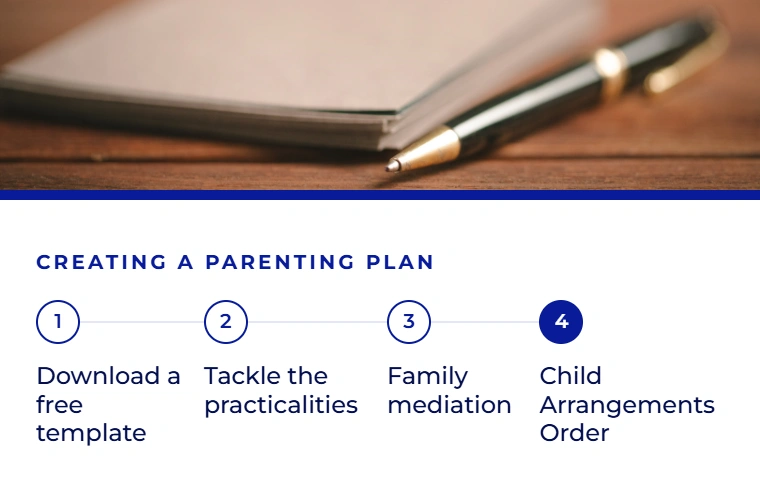
Start by downloading a free template, such as the Cafcass Online Parenting Plan, to give you a starting point without having to worry about high-stress talks with your ex-partner.
Focus on what’s best for your child and tackle the practicalities with your partner, including how you’ll handle:
- Living arrangements.
- Contact with both parents.
- Communication methods.
- Education arrangements.
- Health arrangements.
- Holidays and birthdays.
- Financial contributions if you’re not dealing with formal child maintenance.
You won’t necessarily agree on everything. If you can’t find some middle ground for a particular issue, the next step is to go through family mediation, known as a Mediation Information and Assessment Meeting (MIAM).
Only when all else fails should you begin exploring going to court to get a Child Arrangements Order.
How a family solicitor can help you with parenting plans
Family solicitors do so much more than just file court orders and speak to judges. They can help you understand your legal rights, such as access to your child, and guide you through the drafting process.
Whether you’re using a template or want to create a custom parenting plan, family solicitors can support your family every step of the way. If you’re in a dispute, they can also help you explore other options, such as family mediation.
Working with a solicitor early on in the process can help focus minds on the best interests of your child and reduce the chances of having to go into a stressful court battle later.
Do parenting plans require mediation services or going to court?
Parenting plans don’t actually require any professional intervention at all. Many couples who split up amicably can put their differences aside to make written parenting plans, or even no plan at all.
Remember that parenting plans aren’t legal documents by themselves unless you choose to have them converted into Child Arrangements Orders later.
Additionally, there’s no law requiring you to agree to mediation to create a parenting plan. However, if you can’t agree with your ex and choose to go to court, the law usually requires you to attend an MIAM first. This requirement is waived if there’s evidence of child abuse or an emergency, though.
At VM Family Law, we can step in at the earliest stage of building a parenting plan that works for both sides. Likewise, our expert family law solicitors can make your parenting plan legally binding or obtain a Child Arrangements Order if needed.
If you’d like to learn more about how our solicitors can help you with your co-parenting obligations after your divorce, schedule your free consultation today.