
Christmas is the most magical time of the year for millions of families across the UK. Everyone wants to create those special moments with their children, but separated families often find this to be amongst the most challenging times of the calendar.
In this guide, we discuss how childcare arrangements work over Christmas, and how you can tackle this issue to do what’s best for your child.

Child Arrangement Orders over Christmas
No law sets out how children spend their Christmases after a divorce. Any arrangement is governed by Child Arrangement Orders, if your case has been before The Family Court.
If you do have a formal order in place, it should already cover the Christmas holidays. Regardless of your feelings on it, a formal order must be followed, unless both parents agree to an alternative arrangement.
If you feel that holiday arrangements are fundamentally unfair, or your circumstances have changed, you can apply to court to vary your Child Arrangement Order if it is not possible to negotiate a change with the other parent.
For parents who don’t have one in place, the starting point is to speak to your former partner and attempt to find some common ground. If this doesn’t work then you can refer the matter to mediation. If your ex refuses your proposals or makes unreasonable demands, applying for a Child Arrangement Order may be the best option for you.
Popular Christmas child contact schedules

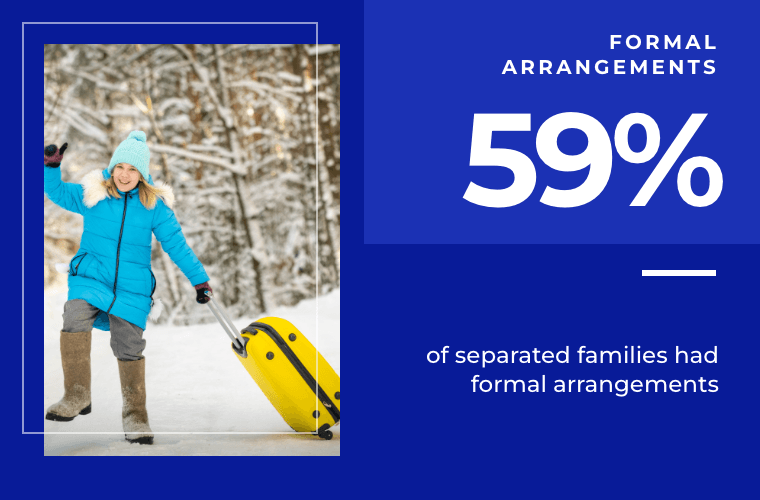
How parents and children spend Christmas together depends on the family and the child’s wishes, with no concrete legal standard for working this out. With 3.8 million children in separated families across the country, families may lean on several informal or formal arrangements.
Here’s a breakdown of some of the more common Christmas schedules:
Alternate Christmases, with one year spent with one parent and the next year spent with the other.
A split Christmas day, where the morning is spent with one parent and the rest of the day with the other.
A 50-50 split of the school holidays, such as spending Christmas itself in one household and New Year’s Eve and New Year’s Day in another and then alternating the arrangement the following year.
Alternatively, some families don’t make any special arrangements for Christmas and simply carry on their regular schedule.
Location is often a huge challenge for many separated parents. It’s much easier if you live close by, but when you live far apart, many scheduling options simply become impractical.
Whatever schedule you choose, it’s always preferred that you come to an amicable arrangement yourself. If this is impossible, though, it may be time to apply for a formal Child Arrangement Order.
Agreeing Christmas arrangements: Do you need a Child Arrangement Order?
Many families agree on Christmas contact between themselves with little more than a conversation, a phone call or an email exchange. There’s no law that requires you to have a court-defined schedule in place.
Naturally, the practicality of this pathway depends on your relationship with your ex-partner. In the event you’re not on speaking terms, or you’re unable to talk without an argument breaking out, you may need a court to intervene.
Court orders may be a simple Child Arrangement Order, which covers the general day to day arrangements, but usually do cover a range of special occasions including Christmas itself. If any of the following apply to you, it may be time to seek legal clarity:
One parent threatens to withhold the child from spending time with the other half of their family.
There are serious disputes regarding taking children abroad, including travel at Christmas.
Informal discussions are not progressing.
You have genuine child safety concerns.
Working with an expert in family law can help you formulate a plan and if necessary a court application and guide you through the legal process. We strongly recommend enlisting an expert, even if it’s just for a quick consultation, so that you know your legal rights and how everything works.
Note that The Family Court in England and Wales is legally bound to prioritise the welfare of children beyond the desires of either parent.
How does travel abroad work over Christmas?
Taking a child abroad for a holiday is a popular way to celebrate. Do be aware that if you are intending to take your child abroad, you’ll need consent from everyone who has parental responsibility or a court order.
How this works depends on your current arrangement. For example, a “lives with” order may allow you to take your child abroad for up to one month. However, if there are child safety concerns or consent has been refused, you should seek legal advice immediately.
How mediation might help solve child arrangement issues over Christmas
Are you making no progress with your ex-partner when discussing Christmas?
An alternative to court is to go to mediation. In England and Wales, mediation provides a neutral meeting point with a solid structure to work through points of contention. Mediators don’t take sides and guide discussions, so that parents can focus on the best possible outcome for their children.
Mediation is far cheaper and less stressful than going to court, which is why parents often use it with the help of a solicitor. Of course, mediation might not always deliver a positive outcome, especially when parents simply refuse to compromise.
At VM Family Law, our experienced divorce solicitors provide independent legal advice, can sense-check Christmas scheduling proposals, and analyse the legal impact of anything you agree to. Likewise, we can also pursue Child Arrangement Orders if it comes to that. If you’d like independent legal advice, contact one of our family law experts for a consultation today.